
The Ideal Piano Training (Part 1)
In this first part of The Ideal Piano Training series, we explore the crucial early years of piano study (up to ABRSM Grade 3), including how to build strong sight reading, healthy technique, and—most importantly—a love for music. Designed for parents and teachers, this guide explains how daily reading practice and structured progression lay the foundation for long-term success in piano exams and beyond.
Tomas Iglesias
2/18/20263 min read
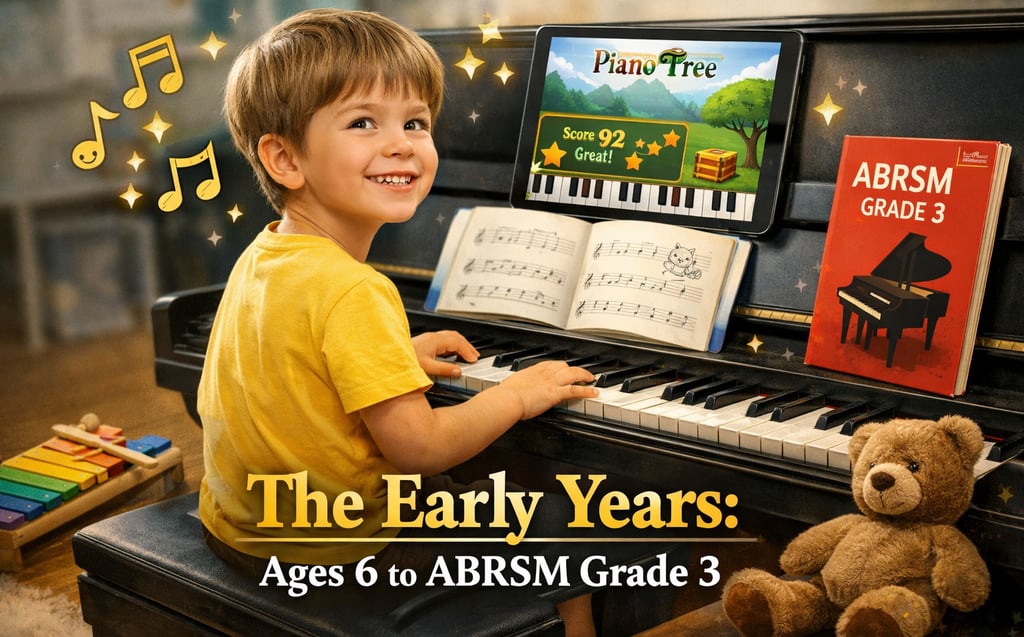
The Early Years: Ages 6 to ABRSM Grade 3
When should a child start piano lessons?
In an ideal training scenario, most children begin between ages 5 and 6. If a child is not ready at 5 — perhaps attention span is still developing — starting at 6 or even 7 makes no meaningful difference in the long run.
Even students who begin at 10, 15, or 21 can reach a professional level if they are committed. I have personally worked with late starters who completed diplomas and now work as professional musicians.
But since we are describing ideal training, let’s focus on the typical early starter:
A six-year-old child beginning piano lessons.
This stage usually lasts until approximately ABRSM Grade 3.
At this level, there are three goals.
One is paramount.
Two are equally important foundation
Goal 1 (Most Important): The Child Must Enjoy Piano
Nothing matters more in the first years than enjoyment.
If the child enjoys lessons:
They practice.
If they practice, they improve.
If they improve, they enjoy it even more.
This creates a virtuous cycle.
Humans naturally enjoy doing what they are good at.
In my experience, young children enjoy:
Playing easy pieces they can succeed at
Clapping rhythms
Musical games
Laughing during activities
Feeling successful quickly
Piano at age six should feel like structured play.
Gradually — very gradually — the teacher can become more demanding. But in the beginning, it is far safer to be slightly “too kind” than too strict. If lessons become associated with stress, fear, or constant correction, the child may form a negative emotional memory around music.
Ask yourself: what is one happy memory from your childhood?
That is the emotional atmosphere we want at the start.
Goal 2: Sight Reading (Reading Notes and Rhythm in Time)
This is where many training systems fail.
In the early years, a child should read new music every single day.
Sight reading is not optional — it is foundational.
A child who can read fluently:
Learns repertoire faster
Feels independent
Can join school ensembles and bands
Feels confident when given new music
Progresses smoothly through ABRSM grades
Most importantly:
A child with strong sight reading can make music immediately.
And making music is fun.
Even if technique is not perfect yet, good reading allows real musical experiences. And real musical experiences create motivation.
There are traditionally two ways to develop early sight reading:
Option 1: Daily New Books at Home
Parents can borrow level-appropriate beginner books and introduce new short pieces daily.
The difficulty?
This requires parents to:
Understand reading levels
Recognize rhythm errors
Correct wrong notes instantly
Choose appropriate repertoire
Most families are not trained musicians. It becomes stressful.
Option 2: A Structured Sight-Reading System
A structured program removes guesswork.
For example, Piano Tree was designed specifically for this stage. It:
Provides instant feedback
Scores accuracy and rhythm
Is gamified (children enjoy earning points)
Automatically adjusts difficulty
Requires no musical knowledge from parents
Encourages daily reading through “Adventure Mode”
Instead of parents searching for new material, the system is already sequenced.
Daily exposure to new music builds fluent readers.
And fluent readers become confident pianists.
Goal 3: Technique (But in Proportion)
Technique matters — but it must be taught intelligently.
Some teachers focus heavily on perfect hand position from the very first lesson. While the intention is good, we must remember:
Six-year-olds are still developing physically.
Their bones are not fully formed.
Strength and coordination are still emerging.
Standing firmly on finger 5 can be physically difficult.
Yes, technique should be introduced and gently reinforced at every lesson.
But extreme rigidity at this age can:
Frustrate the child
Slow musical progress
Reduce enjoyment
In the early years, we prioritize:
Relaxation
Natural movement
Basic hand shape awareness
Good posture
Simple finger independence
Perfection is not the goal.
Healthy development over time is.
Strong technique will be built gradually during the intermediate years.
What Does an Ideal Early Practice Routine Look Like?
For a student aged six working toward ABRSM Grade 3:
5–10 minutes sight reading daily
Repertoire practice (short pieces they can mostly manage)
Simple technical exercises
Rhythm clapping or counting aloud
Consistency matters more than duration.
Ten focused minutes every day is better than one long session per week.
By the End of This Stage (Around ABRSM Grade 3)
An ideally trained student should:
Read basic notation fluently
Keep steady rhythm
Play with both hands comfortably
Show relaxed natural technique
Practice independently (with light supervision)
Enjoy the instrument
Most importantly:
They should not fear new music.
That confidence becomes the foundation for the intermediate years.