
The Ideal Piano Training (Part 2): Intermediate Piano Lessons from ABRSM Grade 3 to Grade 6
How should intermediate piano students train between ABRSM Grade 3 and Grade 6? In Part 2 of The Ideal Piano Training series, we explore how daily sight reading, structured chord and scale training, and practical harmony (triads, inversions, and lead sheets) transform students from note-readers into real musicians. This stage is critical for long-term success in ABRSM exams and for developing musical independence at the piano.
2/23/20263 min read
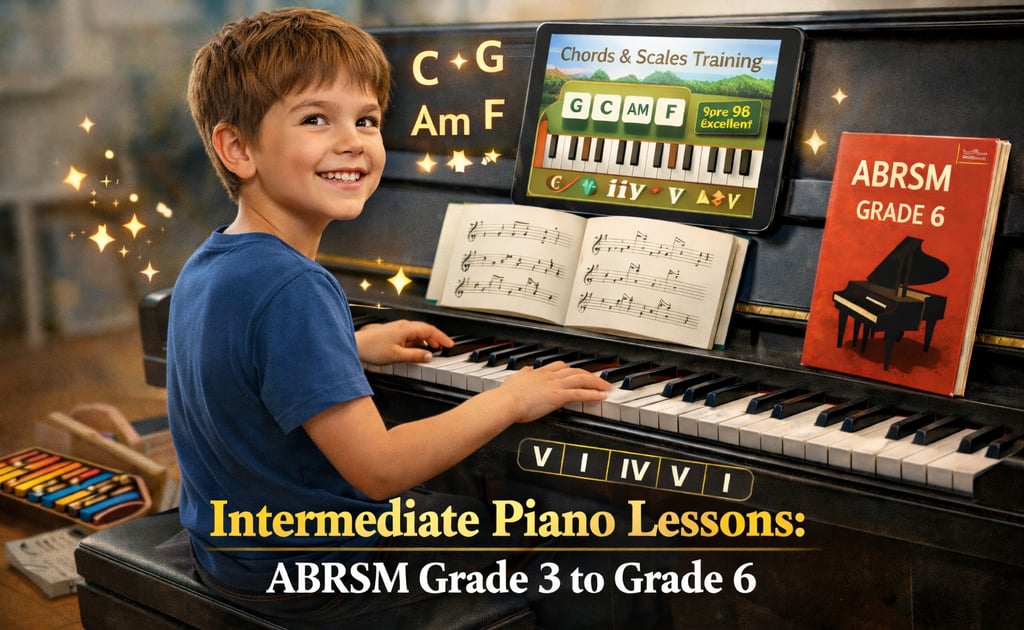
The Ideal Piano Training (Part 2)
The Intermediate Years: From ABRSM Grade 3 to Grade 6
If the early years (up to ABRSM Grade 3) were about building foundations,
the intermediate years are about building understanding.
This stage — typically covering ABRSM Grades 4, 5, and 6 — is where a student stops merely playing notes and begins understanding how music works.
It is also the stage where many students either accelerate… or quit.
The difference is structure.
What Should Be Solid Before Entering the Intermediate Stage?
Before moving into ABRSM Grade 4–6 repertoire, an ideally trained student should already have:
Daily sight reading habits
Natural basic technique and posture
Steady rhythm
Reading fluency in simple keys
If sight reading was trained daily from the start, the student no longer fears new music. A structured system like Piano Tree makes this habit far easier to build consistently.
Technique also begins to feel automatic. The student doesn’t need constant reminders about curved fingers or relaxed wrists.
When the body and reading are stable, the mind becomes free.
And that is when real musical understanding begins.
The Big Shift: From Decoding Notes to Understanding Structure
At intermediate level, we introduce harmony — but not in an academic, intimidating way.
Instead, we begin with something practical and musical:
Learning Piano Chords Systematically
This stage focuses on:
Major and minor triads
Root position first
Then inversions
Reading chord symbols (C, G, Am, F, etc.)
Students begin playing lead sheets, which is one of the most effective ways to teach harmony to intermediate piano students.
Step 1: Melody + Root Position Chords
Right hand: simple melody
Left hand: triads in root position
This continues until reading chord symbols becomes automatic.
At the same time, we point out simple chord progressions that appear everywhere:
V–I
IV–V–I
In both major and minor
Students begin recognising patterns inside real music — including their ABRSM exam pieces.
Music starts to make sense.
Why Inversions Are a Turning Point
After root position feels comfortable, we introduce inversions.
This dramatically improves:
Left-hand movement efficiency
Smoothness between chords
Technical control
Professional sound
Instead of jumping across the keyboard, the hand stays mostly in one area.
Students feel more advanced — and motivation increases.
Structured Chord and Scale Training (Piano Tree)
At this stage, structured daily training becomes essential.
Inside Piano Tree, the Chords and Scales Training section is specifically designed for students around ABRSM Grade 3–6.
It works in two layers:
1) Abstract Understanding
Students learn triads, inversions, and scales clearly and systematically.
2) Immediate Application
They then apply those chords to real songs with backing tracks.
This develops:
Harmonic awareness
Left-hand coordination
Ear training
Rhythm stability
Stylistic understanding
Technical control
Instead of memorising theory, students experience how harmony builds music.
This makes intermediate piano lessons far more engaging and effective.
How Chord Training Improves Sight Reading
This is one of the most important cognitive upgrades in piano development.
At beginner level, students read note by note.
At intermediate level, the brain starts grouping information.
Instead of seeing:
A – C# – E
The brain recognises:
A major.
Instead of processing G – B – D – F individually,
the student recognises:
G7.
This process — called “chunking” — significantly improves piano sight reading speed and accuracy.
Students preparing for ABRSM Grade 5 and Grade 6 often struggle with reading because they still think vertically note by note.
Students who understand harmony read in units.
That makes everything easier.
Why Many Students Quit Around Grade 5
This is a critical stage in piano training.
If a student:
Only learns exam pieces
Does not understand chords
Does not practice structured sight reading
Does not see patterns
Then ABRSM Grade 5–6 repertoire starts to feel overwhelming.
But when harmony and sight reading are trained daily:
Repertoire is learned faster
Memory improves
Musical expression becomes easier
Confidence increases
Students can play outside the exam system
They begin to feel musically independent.
And independence is motivating.
What Should Be Achieved by ABRSM Grade 6?
By the end of the intermediate years, an ideally trained student should:
Read fluently in multiple keys
Recognise common chord progressions instantly
Use inversions naturally
Apply harmony to lead sheets
Maintain relaxed, controlled technique
Understand the structure behind the music
Prepare efficiently for ABRSM Grade 6 exams
Most importantly:
They no longer just play pieces.
They understand music.
The Role of Structure in Intermediate Piano Training
The intermediate years are where discipline and enjoyment must balance carefully.
Daily sight reading (for example through Piano Tree)
+
Systematic chord and scale training
+
Thoughtful repertoire preparation
Creates a student who is technically stronger, harmonically aware, and musically confident.
This is the bridge between beginner and advanced pianist.