
The Ideal Piano Training (Part 4)
What should piano students do after ABRSM Grade 8? In Part 4 of The Ideal Piano Training series, we explore the main professional pathways available to advanced pianists, including diploma-level classical performance, jazz and popular music, composition, church music, and teaching. This guide explains how advanced sight reading, technique, harmony, and figured bass shape each path, helping students choose the right direction for a long-term career in music.
4/7/20262 min read
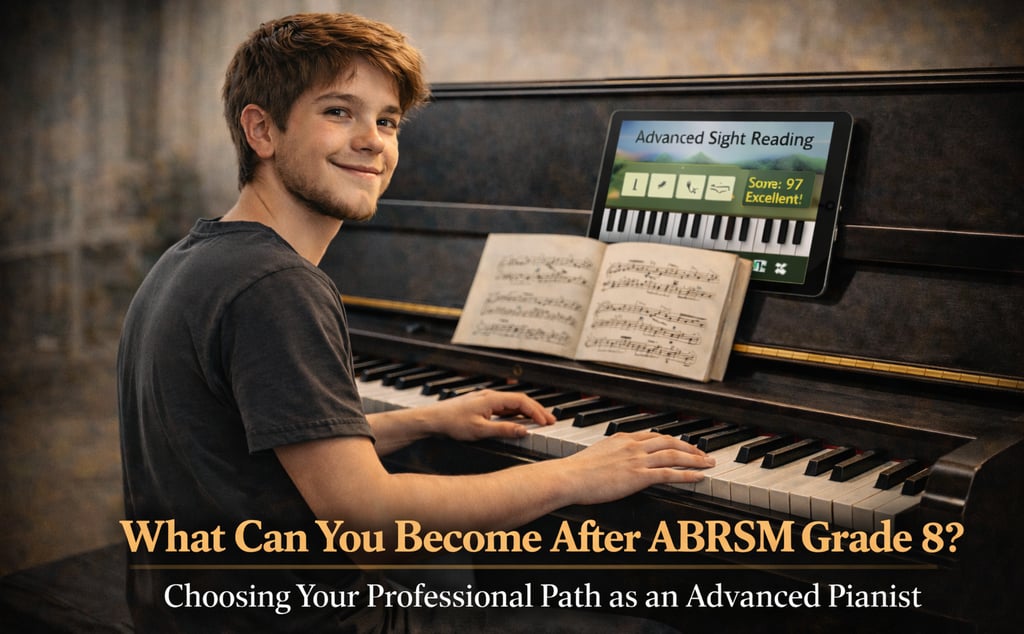
The Professional Years: Choosing Your Path After Grade 8
By the time a student completes ABRSM Grade 8, they are no longer simply a student.
They are a musician.
At this point, a decision becomes necessary.
The student can continue progressing — but now with direction.
While it is possible to explore multiple paths, in most cases it is best to choose a primary focus.
Let’s look at the main professional directions that naturally emerge from this training.
Path 1: The Classical Pianist (Diploma Track)
The most direct continuation is the diploma pathway.
This includes:
ATCL / DipABRSM
LTCL / LRSM
FTCL / FRSM
This path builds on everything developed so far and focuses heavily on two core skills:
1. Advanced Technique
Control at high tempos
Tone production
Voicing and balance
Endurance for large-scale works
2. Advanced Reading Ability
Reading becomes critical at this level.
Some diploma exams include sight reading, and even when they do not, the ability to learn repertoire efficiently depends on it.
At this stage, sight reading should be fully internalised.
In terms of structured progression, this corresponds roughly to:
Piano Tree Path Level 8–10 → sufficient to pass
Piano Tree Path Level 12 → strong confidence and security
There is always an element of unpredictability in exams, but strong reading ability reduces risk significantly.
Students who continue daily sight reading at this level learn repertoire faster, leaving more time for interpretation and technique rather than decoding notes. A structured system keeps this habit consistent even at diploma level.
Path 2: The Popular / Jazz Pianist
Another common direction is popular music.
This includes:
Jazz piano
Pop piano
Styles such as bossa nova or tango
This path relies less on reading large classical scores and more on:
Harmony
Chord fluency
Improvisation
Rhythm and groove
Style awareness
Many professional opportunities exist here:
Cruise ships
Hotels and bars
Bands
Session work
Interestingly, the strongest jazz pianists often have:
Good classical foundations
Strong sight reading
Deep harmonic understanding
The training from earlier stages transfers directly.
Path 3: The Composer (Film, Media, or Concert Music)
For students interested in composition, the direction shifts again.
As a working film composer, I strongly recommend:
Serious study of figured bass
Structural analysis
This is the foundation.
From there:
Jazz expands harmonic language (20th century vocabulary)
Tango connects late Romantic and modern harmony
Orchestration develops through voicing (what we play on the piano becomes what we write for instruments)
Film music, in particular, draws heavily from these traditions.
A clear example is John Williams, whose writing combines classical structure with jazz-influenced harmony.
For this path, structured training is essential.
A dedicated Harmony and Figured Bass course builds the theoretical foundation
Piano Tree supports practical application through exercises such as:
Cadences
Figured bass realisations
Chorales
Counterpoint
Canons
This combination connects theory directly to the keyboard.
Path 4: The Church Pianist
This path is often overlooked but highly valuable.
It shares similarities with classical training but places greater emphasis on:
Sight reading
Accompaniment skills
Real-time adaptation
Church pianists must:
Read quickly
Harmonise efficiently
Support ensembles and singers
In many ways, this role depends more on harmonic fluency than on virtuosic technique.
Path 5: The Piano Teacher
Many musicians — including composers — also become teachers.
This is not a fallback.
It is a profession that requires:
Strong sight reading
Knowledge across multiple styles
Understanding of technique
Ability to diagnose problems
Clear communication
The best teachers are not specialists in only one area.
They are integrators.
Combining Paths
These paths are not exclusive.
In fact, many successful musicians combine them:
Piano teacher + film composer
Classical pianist + teacher
Jazz pianist + session musician
Composer + performer
This flexibility is one of the strengths of a complete piano education.
The Real Outcome of Ideal Piano Training
If the full system has been followed:
Early years → enjoyment + reading
Intermediate years → harmony + structure
Advanced years → depth + interpretation
Then the result is not just a pianist.
It is a complete musician.
One who can:
Read
Understand
Adapt
Perform
Create
And most importantly:
Choose their path with confidence.